
Background
Southern American English is a variety that is known for its “drawl” or “twang.” Speakers in the South of the US have varying features influenced by settlers of different cultures, even including British roots.1 Additionally, the Ulster-Scotts (sometimes referred to as the Scotts-Irish) began inhabiting the South in the 18th century.2
Later, slavery contributed to the influx of immigration to the South. Because agriculture was the main economic industry of the Southern states of America, this created a hub for the importation of enslaved people to support said industry. While horrific, slavery provided the means for language change through language interaction in the South.3 Over time, this interaction produced lingering phonological and lexical features.
Modern Variation in the Region
Texas was settled later than some other parts of the South, which affects the dialect slightly. The migration to Texas mainly consisted of Southern peoples, which is why they still heavily influence the dialect. Furthermore, Texas being neighbors with Mexico affected the dialect heavily. 4 While variation exists between states, it exists within states too. “City Folk” (people who live in urban centers), are less likely to have the same accent as more rural areas, yet might carry some of the same lexical features.
A note: There are dialects within the umbrella of Southern American English. Please look at the African American Vernacular English and Appalachian English pages to learn more.
Pronunciation
The phonology of Southern American English is characterized by distinct vowel shifts and rhythmic patterns that differentiate it from Standard American English. These features are not merely “accents” but represent a systematic set of rules governed by the region’s linguistic history. The following sections detail the specific phonetic transformations and pronunciations common across the South.
Southern Vowel Shifting
Southern American English is most famously defined by the Southern Vowel Shift, a chain reaction where the pronunciation of front vowels moves to different positions in the mouth. In this shift the monophthongization of the [ai] vowel began a chain reaction which caused TRAP to raise, DRESS to raise, and KIT to raise. Once these vowels raised it caused the FLEECE and FACE to Lower. The following diagram represents this shift visually.
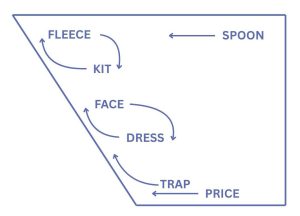
The above diagram is adapted from The Atlas of North American English : Phonetics, Phonology and Sound Change.5
Monophthongization of /ai/ (PRICE)
One of the most recognizable features of Southern speech is the conversion of the diphthong /ai/ (as in ride or time) into a long, single vowel sound [aː]. The weakening or loss of the “glide” (the second half of the vowel) is a primary marker of the Southern Vowel Shift.6
Examples:
- “I like to ride my bike” would sound similar to “Ah lak to rahd mah bahk.”
- [ aː laːk tu raːd maː baːk]
- VOSE Southern 1 (0:19): “Spider”
- [spaːdəɹ]
TRAP Raising
In many Southern varieties, the vowel /æ/ in words like apple undergoes a “raising” and “fronting” process. This raising is a hallmark of the first stage of the Southern Vowel Shift, where the end vowel moves toward the position of /e/ or even /i/, often acquiring a complex gliding quality.7
Example:
- “Apple” can sound like “Ay-pull.”
- [eipɫ]
- VOSE Southern 1 (0:17): “Hammer”
- [hæ̝mɹ]
KIT and FLEECE Swap
The KIT and FLEECE vowels, or the high-front lax vowel /ɪ/ and the high-front tense vowel /i/, are central to the Southern Vowel Shift. In this shift, these vowels undergo a “swap” in their relative positions in the vowel space. The lax vowel KIT moves forward and upward, while the tense vowel FLEECE moves downward and toward the center. This reversal of the traditional tense/lax relationship is a defining characteristic of Southern American English.8
Example:
- Alabama 3 (0:21): “On the first morning she washed her face, put on a plain white dress and a fleece jacket, picked up her kit and headed for work.”
- [flɪs] and [kit]
FACE and DRESS Swap
Similar to the high-front vowels, the mid-front vowels FACE (/e/) and DRESS (/ɛ/) participate in a parallel “swap” within the Southern Vowel Shift. As the shift progresses, the short-front vowel DRESS moves upward and forward into the space formerly occupied by FACE, often taking on a tense quality. Simultaneously, the long-front vowel FACE shifts downward and toward the center of the mouth, becoming more lax or open in its nucleus.9
Example:
- Alabama 3 (0:21): “On the first morning she washed her face, put on a plain white dress and a fleece jacket, picked up her kit, and headed for work.”
- [fɛs] and [dɹɛis]
Fronting of [u] (GOOSE)
A significant element of the Southern Vowel Shift involves the fronting of back vowels. The vowel [u] (as in spoon or goose) is often produced much further forward in the mouth than in other dialects, sometimes sounding closer to a “yoo” sound.10 11
Examples:
- “Spoon” sounds almost like “spewn.”
- [spɪun]
- VOSE Southern 1 (0:28): “Shoe”
- [ʃɪu]
The Pin-Pen Merger
In Southern dialects, the distinction between the front vowels [ɪ] and [ɛ] is lost specifically when they occur before nasal consonants like [n] or [m]. This merger results in words like pin and pen or him and hem being pronounced identically. 12
Examples:
- “Can you buy me a pen?” and “Can you buy me a pin?” would sound like the same sentence, but would differ greatly in meaning.
- [pɛn] and [pɪn]
- VOSE Southern 1 (1:26): “Seven”
- [sɛvɪn]
- VOSE Southern 1 (2:00): “End”
- [ɪnd]
The Southern Drawl and Vowel Breaking
The “drawl” is often misunderstood as merely slow speech, but phonetically it involves “vowel breaking,” where short front vowels are lengthened and develop a gliding quality. This often involves the insertion of a schwa-like sound, turning a monosyllabic word into something approaching two syllables. 13
Examples:
- “There” may sound like [ðɛiɚ].
- “Cat” may sound like [kaiət].
- “Bad” may sound like [bæiəd].
- Tennessee 17 (3:12): “Jackson, Tennessee was well known for Carl Perkins, Casey Joans; but also West Tennessee was known for not wantin’ to get out of segregation.”
- [dʒaʊəns]
Feel-Fill Merger
In many Southern dialects, the distinction between the high front tense vowel [i] (as in feel) and the high front lax vowel [ɪ] (as in fill) is neutralized before the liquid consonant [l]. This merger creates homophones where both words are typically pronounced with the lax vowel.14
Examples:
- “I feel sick” sounds like “I fill sick.”
- [fɪɫ]
- “That’s a steep hill” sounds like “That’s a steep heel.”
- [hiɫ]
- LiteLinguistics (00:44): “The football field was filled with players.”
- [fɪɫd]
Th-stopping
This feature involves the replacement of the interdental fricatives [ð] (voiced “th”) and [θ](voiceless “th”) with the alveolar stops [d] or [t] when they occur at the beginning of a syllable. This is particularly common in certain sub-regional Southern dialects and socio-ethnic varieties, where the tongue hits the back of the teeth rather than sliding between them.15
Examples:
- “This” can sound like “Dis.”
- [dɪs]
- “Think” can sound like “Tink.”
- [tɪnk]
- Tennessee 17 (3:41): “I went to an all segregated school for eight years, and then I went to Northside, uh, highschool . . .”
- [dɛn]
Th-Fronting
Unlike stopping, Th-Fronting typically occurs in the syllable-final position, where the interdental fricative [θ] is replaced by the labiodental fricative [f] or [v]. This is a prominent feature that is observed in broader Southern folk speech patterns where the “Th” sound is moved “forward” to the lips.16
Examples:
- “Smooth” can sound very similar to “Smoov.”
- [smuv]
- “Tooth” can sound a lot like “Toof.”
- [tuf]
- Tennessee 17 (1:08): “The letter implied that the animal could be suffering from a rare form of foot and mouth disease.”
- [maʊf]
Post-vocalic /r/ Deletion (Non-rhoticity)
While becoming less common in younger generations, older Southern varieties, particularly in coastal and “Plantation” areas, often drop the [ɹ] sound when it precedes consonants or pause but NOT before vowels. In the southeastern United States, an African substrate influence likely played a role, causing speakers to favor English speech options like r-lessness because it was more consistent with the structure of certain African languages.17
Examples:
- “Father” and “Farther” can sound the same.
- “Park the car” can be pronounced as “Pahk the cah.”
- Alabama 4 (00:58): “This made her feel sorry for the bird.”
- [bɚd]
G-Dropping in Present Participles (SWIMMING)
While most dialects will do this to some extent in casual speech, Southern speech tends to get more harshly criticized for it. In Southern White English, the velar nasal [ŋ] at the end of -ing words is frequently replaced with the alveolar nasal [n]. Rachael Meghan Allbritten notes that this “g-dropping” is a highly recognizable feature that often influences how listeners perceive the “Southernness” or social status of a speaker. 18
Examples:
- “Swimming” will sound like “Swimmin’.”
- [swɪmɪn]
- VOSE Southern 1 (00:57): “Brushing”
- [bɹuʃin]
Pronunciation of GFTA Words
When applying Southern phonetic rules to standard assessment words used in the Goldman-Fristoe Test of Articulation (GFTA), specific dialectal shifts emerge. It’s important to point out that these features will vary based on individual. Not all individuals will have the same features mentioned above things like age and place of origin may have an impact on which features are most salient. The following is an example from a singular individual of how these features may appear. These examples illustrate how regional phonology interacts with standard lexical items.
The timestamps below are sourced from VOSE Southern 1.
1. Door 00:02 [doʊɹ] 2. Boy 00:06 [bɔʊɪ] 3. Spider 00:20 [spaːdɹ] 4. Knife 00:25 [naːf] 5. Slide 00:30 [slaːd] 6. Lion 00:36 [laːn] 7. Tiger 00:41 [taːgɹ] 8. Finger 00:43 [fɪŋɹ] 9. Elephant 00:48 [ɛlɪfɪnt] 10. Vegetable 00:57 [vɛtʃtəbl] 11. Brushing 00:58 [bɹʌʃɪn] 12. Yellow 01:01 [jɛlə] 13. Frog 01:03 [fɹaʊg] 14. Juice 01:21 [dʒʉs] 15. Zoo 01:23 [zʉː] 16. Five 01:25 [faːv] 17. Seven 01:26 [sɛvɪn] Grammar
There are a wide variety of grammatical features that can be considered distinctively Southern. Some of these features are distinct to rural communities or varieties of Black Southern English. While distinct varieties of Southern English may overlap with features presented here these features are used most widely across Southern US English.
Double Modals
In “standard” American English only one auxiliary modal may be included, but in Southern US varieties these can be stacked. These auxiliary modals come in pairs and include the words may/might, can/could, should/shall, and will/would. These constructions are most common in the stretch between Virginia and Texas.19
Examples:
- “I might could do that.”
- “Hoping having my Spanish final on Cinco de Mayo may will bring me some luck.”
- “Need a nap but don’t think I should might be up all night again.”
- “We might can go up there Saturday.”
Second Person Pronouns
In Standard American English we lack a second person plural pronoun akin to the “Vosotros” form in Spanish. Southern US varieties have made up for this by creating Y’all (yall, ya’ll, yawl). There is significant debate on how it arose. Some see it as a contraction of (you+ all) others a contraction of ya+all (ya being a fast/informal version of you). Or perhaps it descends from Scots-Irish Ye aw.20
Examples:
- “How have Y’all been?”
- “There’s y’all.”
- “Y’all come on down here.”
Fixin’ to
Means something akin to preparing to or intending to (another way of saying “about to”). There is substantial debate over how the form came to be, and the form is difficult to elicit in formal contexts.21
Examples:
- “I’m fixin’ to do the dishes.”
- “She was fixin’ to go to bed.”
Irregular verb patterns
In “standard” American English there are many verbs which in some way or another have become irregular or do not follow the typical “rules of verbs”. In white Southern US English some of these verbs have become regularized to follow the typical rules. For example riz instead of rose, brung/brang instead of brought and swum instead of swam.22
Examples:
- “I brung them yesterday.”
- “He riz up out of nowhere.”
Be + S
Typically in “standard” varieties to indicate ongoing action constructions like “it’s sometimes like that” or “It’s like that” are used. While Southern US English may not use habitual Be like African American Varieties, it has picked up a similar construction with Be + S which takes the place of where is would typically go.23
Examples:
- “Sometimes it bes like that.”
- “He bes over there.”
Singular s on plural verbs
In addition to regularizing verbs, Southern US English sometimes adds a singular s onto plural verbs.24
Example:
- “Me and my brother gets into fights.”
Plural -s absence with measurement nouns
When talking about measurements or markers of physical distance the plural -s is sometimes omitted.25
Examples:
- “The station is four mile down the road.”
- “He weighs seven pound.”
Negative Concord
There is a common misconception that two negation words make a positive, which is a bleed over from mathematical fields. In Southern US English, however, there is nothing illogical about including double (sometimes more) negation.26
Examples:
- “There ain’t no dog over there!”
- “I haven’t never told nobody nothing like that!”
- Texas 14 (02:20): “He didn’t eat chicken—nothing. Didn’t eat no fried chicken at all.”
Perfective Done
Perfective done, also called preverbal done can have multiple uses in different contexts. It can be used to express that the action described has come to an end or may convey shock or surprise on the part of the speaker.27
Examples:
- “I done already did that.”
- “You done hurt my feelings.”
- Alabama 2 (02:23): “You done lost your accent.”
Lexical Items
Below is a list of some common unique lexical items sourced from the Dictionary of American Regional English28 that are found in Southern US English:
- coke: ‘a softdrink’
- snap bean: ‘the common bean’
- buggy: ‘shopping cart’
- Devil’s beating his wife: ‘sunshower’
- ugly: ‘rude’
- crawfish: ‘Crayfish’
- adder: ‘snake’
- Abraham Lincoln: ‘five dollar bill’
- cut on / cut off / cut out: ‘turn on / turn off / turn out, typically lights’
- yonder: ‘over there’
Pragmatics
Deferential Politeness
Many speakers of Southern US English rely heavily on politeness tactics in their speech to convey the point they truly mean to make. This reliance on politeness is called Deferential Politeness.
Below are several methods of such politeness outlined by English in the Southern United States (Nagle & Sanders) recorded below. 29
Greetings and Forms of Address
Many speakers of Southern American English will include sir/ma’am in the reply to a yes/no question to indicate respect and polite submission for whomever they are speaking with or friendly solidarity especially when used in a response to a younger speaker.
Many women who speak Southern AE use address forms such as “honey” or “darling” as a sort of ritual deference of respect and kindness.
Conditional Syntax and Indirectness
Expressions of negative politeness through indirect methods of expression (so as to not take full responsibility of their assertion). Often includes using conditional syntax via if-constructions to hedge: “I ain’t got one thing if I ain’t got time.” Conditional syntax can also appear in requests: “If you be good enough to take the newness off it, I believe I could stand me a taste.” This same construction can be used to mitigate a suggestion: “I wouldn’t look for’m to show up if I was you.”
Evidentiality
Including terms such as “believe,” reckon,” “have the feeling,” and “think” to indicate the certainty of what has been suggested.
Examples:
- “You already said that once I believe.”
- “You reckon we ought to get help?”
- “I have the feeling that we might be on the wrong road.”30
- Montgomery. Michael, The Crucial Century for English in the American South, New Perspectives on Language Variety in the South : Historical and Contemporary Approaches, University of Alabama Press, 2015. ProQuest Ebook Central 97–99
- Algeo, John The origins of Southern American. English in the Southern United States, edited by Stephen J. Nagle, and Sara L. Sanders, Cambridge University Press, 2003. ProQuest Ebook Central, pp 10–16
- Schneider. Edgar, Earlier Southern Englishes in Black and White Corpus-Based Approaches. New Perspectives on Language Variety in the South: Historical and Contemporary Approaches, University of Alabama Press, 2015. ProQuest Ebook Central.
- Bailey, Guy and Tillery, Jan. Texas English. Do you speak American? https://www.pbs.org/speak/seatosea/americanvarieties/texan/
- Labov, William, Sharon Ash, and Charles Boberg. The Atlas of North American English. Berlin: Walter de Gruyter, 2005.
- Thomas, Secrets Revealed by Southern Vowel Shifting, 150–151
- Thomas, Secrets Revealed by Southern Vowel Shifting, 163.
- Labov et al., The Atlas of North American English, 2005.
- Labov et al., The Atlas of North American English, 2005.
- Thomas, Secrets Revealed by Southern Vowel Shifting, 158
- Nagle, English in the Southern United States, 132
- Nagle, English in the Southern United States, 2003.
- Thomas, Secrets revealed by Southern Vowel Shifting, 2003.
- Nagle, English in the Southern United States, 135
- Nagle, English in the Southern United States, 151
- Nagle, English in the Southern United States, 151
- Nagle, English in the Southern United States, 71–72
- Allbritten, Sounding Southern: Phonetic Features and Dialect Perceptions, 12–15
- Morin, The semantics, sociolinguistics, and origins of double modals in American English: New insights from social media, 2024
- Nagle, English in the Southern United States, 107–109
- Nagle, English in the Southern United States, 114–117
- Nagle, English in the Southern United States, 117–118
- Nagle, English in the Southern United States, 117–118
- Nagle, English in the Southern United States, 117–118
- Nagle, English in the Southern United States, 117–118
- Schneider, Edgar W.. 2 The Americas and the Caribbean. Berlin, New York: De Gruyter Mouton, 2008. https://doi.org/10.1515/9783110208405
- Martin, Katie. Perfective done. Yale Grammatical Diversity Project: English in North America. (Available online at http://ygdp.yale.edu/phenomena/perfective-done. Accessed on 2026-04-09)
- Joan Houston Hall, Luanne von Schneidemesser, George H. Goebel et al., Dictionary of Regional American English (Harvard University Press, 2013), South. Accessed March 31, 2026. https://www.daredictionary.com/regions?rcode=region.GA#regionsMap.
- Stephen J. Nagle and Sara L. Sanders, English in the Southern United States, 192–195.
- This example was created by the VOSE team, not DARE.