
Resources
Wells’ Lexical Sets
Describing how vowels are pronounced is tricky, especially with all of the different varieties of English, where pronunciations of the same vowel differ based on region. John C. Wells created the lexical sets in 1982 to have a standardized way to refer to words that are historically pronounced with the same vowel and to refer to the phoneme itself.
Below is an abbreviated chart for easier reference. Please note that RP refers to English pronunciations in England, while GenAm refers to what we would consider standard English.
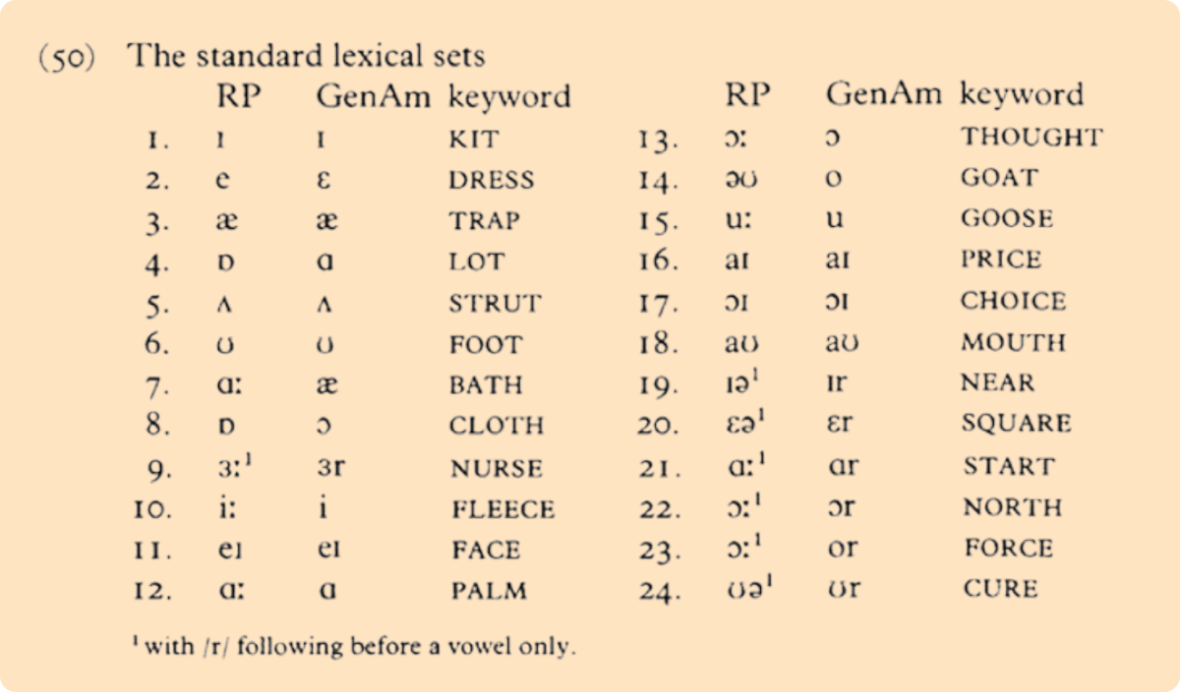
Table via JoeyStanley.com and Fridland et al.
What about B_T?
Although Wells’ Lexical Sets are a useful tool in discussing pronunciation, they are not universally adopted. Another way to refer to pronunciations of vowel sounds is the B_T frame, which takes advantage of a simpler framework. Many researchers opt to use the B_T frame, which is why you may come across it if you are looking at diagrams about vowel mergers or vowel sounds.
Correspondences between the two systems are illustrated in the following table.
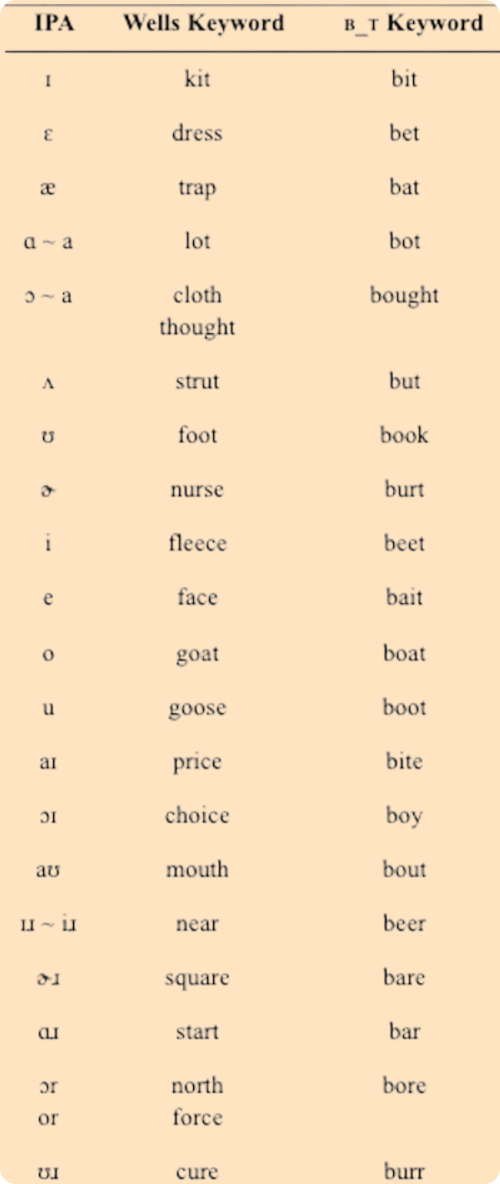
Table via JoeyStanley.com and Fridland et al.
Additional resources
The following links will take you to pages that can give you more insights into the lexical sets.
This source from the University of Pennsylvania goes into more detail about lexical sets in relation to different splits and mergers. It discusses a split in the TRAP vowel in Philadelphia. It also has a good section in IPA.
This source from the Massachusetts’s Institute of Technology has a lot of different charts that explain where in the mouth that the vowels are formed.
This source is from Dr. Joey Stanley, a BYU professor of linguistics, who discusses why Wells’ Lexical Sets are more useful than the B_T frame. He has a lot of interesting blog posts about a lot of lexical set topics.
References
- Walter F. Edwards in A Handbook of Varieties of English: A Multimedia Reference Tool, eds. Edgar W. Schneider et al., vol. 1, Phonology (Mouton De Gruyter, 2004), 383.
- Edgar W. Schneider, Varieties of English: The Americas and the Caribbean (Mouton de Gruyter, 2008), https://doi.org/10.1515/9783110208405.
- Edgar W. Schneider, “Documenting the History of African American Vernacular English: A Survey and Assessment of Sources and Results,” in The Oxford Handbook of African American Language, ed. Sonja Lanehart (Oxford University Press, 2015), 136.
- Schneider, “Documenting the History of African American Vernacular English,” 136; and Walt Wolfram and Mary E. Kohn, “Regionality in the Development of African American English,” in The Oxford Handbook of African American Language, ed. Sonja Lanehart (Oxford University Press, 2015), 143.